
Residential Project at District Shimla
Completion Year 2018
OUR PROJECTS
TSI Architects & Engineers
11/29/20253 min read
A Project Study in Contextual Design by TSI
Shimla, the erstwhile summer capital of British India, occupies a unique position in the pantheon of Indian architecture. Its built environment is a tapestry woven from Victorian, Tudor, and Neoclassical threads, all adapted to the challenging, yet inspiring, geography of the lower Himalayas. At TSI, we recognized that a new residential project in this city demanded more than just modern construction; it required a sensitive and informed dialogue with this rich colonial heritage.
Our recent residential project in Shimla is a definitive statement in this regard: a home that marries the stately romance of the region’s past with the functional demands and structural integrity required for 21st-century hill-station living. This deep dive explores the architectural decisions that shaped this project, positioning it as a benchmark for contemporary heritage revival in the Himalayan context.
I. The Imperative of Climate and Context: An Evolved Form
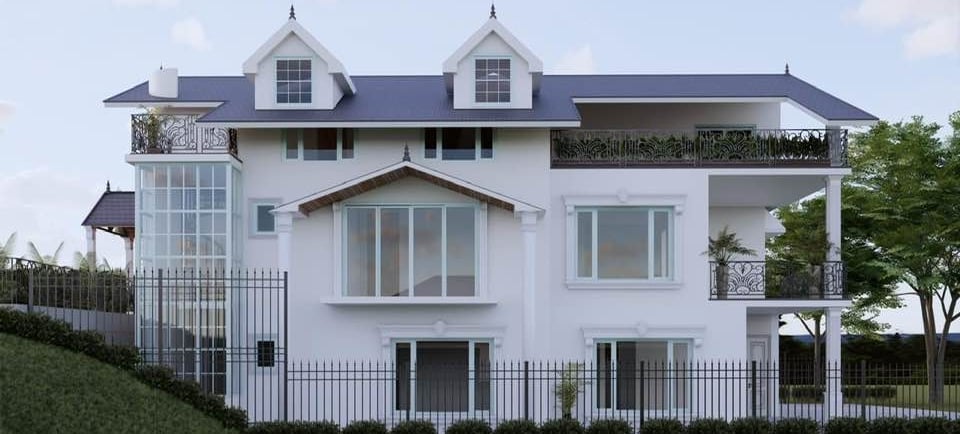
The first and most critical architectural decision in Shimla is the roof. The region's heavy rainfall and significant snow loads necessitate a high-pitched roof profile. Our design embraces this functional necessity as a primary aesthetic feature. The dark, sloping roof—a classic characteristic of hill architecture—ensures efficient water and snow runoff, providing immediate visual and structural reassurance.
Adding to the authenticity are the dormer windows that punctuate the roofline. These not only break the mass of the roof but, more importantly, introduce light and ventilation into the attic space, transforming it from mere storage into valuable, habitable living area. The symmetry and the decorative finials atop the dormers reinforce the Neoclassical/Victorian aesthetic that defined much of Shimla’s original architecture, ensuring the house looks inherently right for its location.
II. Materiality and Palette: A Study in Contrast
The exterior material palette is intentionally a play between light and dark, texture and ornament.
The Façade: The primary structure is rendered in a light, almost pure white finish (stucco or smooth plaster). This choice is an ode to the grand Colonial Revival bungalows, providing a clean, timeless backdrop that stands out elegantly against the deep greens of the surrounding foliage and the stark blue of the mountain sky. This lightness prevents the building from appearing heavy, despite its robust multi-story construction.
The Trim and Frames: To articulate the façade, a subtle but distinct trim colour—a pale mint or subtle seafoam green—is introduced around the window frames and decorative elements. This gentle hue adds depth and character, echoing the traditional use of painted woodwork found in many heritage properties, injecting a layer of delicate charm into the otherwise solid structure. The large, clear glazing, particularly the expansive central bay window, is strategically employed to flood the interiors with much-needed natural light and maximize the unparalleled views.
III. The Art of Ornamentation: Wrought Iron as Narrative
One of the project's most defining architectural features is the extensive and deliberate use of intricate wrought iron work. The dark, detailed railings adorning the numerous balconies and terraces are not merely a safety barrier; they are a historical detail reasserted as a signature design element.
The complex scrollwork—featuring motifs reminiscent of floral and geometric patterns—provides a perfect visual counterpoint to the clean geometry of the walls and the mass of the roof. It introduces the necessary element of handcrafted elegance inherent in the colonial style. Furthermore, by framing the balconies, the wrought iron visually anchors the outdoor spaces, ensuring that the occupants are constantly connected to the panoramic mountain vistas that are the true luxury of a Shimla home.
IV. Bridging Eras: The Transparent Intervention
Perhaps the most fascinating architectural decision—and a defining feature of the design’s commitment to modern function—is the highly glazed, vertical element positioned on the left side of the structure. This multi-sided, tower-like enclosure, entirely clad in a grid of glass, is a brilliant modern intervention.
In a house built on multiple levels on a slope, vertical accessibility is paramount. This glazed structure most likely serves as a dedicated staircase or a private lift shaft. Architecturally, it achieves a powerful juxtaposition: it uses a totally modern material (glass) and form (a clean, vertical column) to insert contemporary function (accessibility, light) directly into the traditional massing. It is a moment of architectural 'truth,' where the needs of 21st-century living are celebrated with transparency, without compromising the heritage aesthetic of the main structure. It ensures the house is not just beautiful but universally functional and future-proof.
V. Spatial Dynamics: Designing for the Landscape
The overall massing and distribution of elements—the central focus, the symmetrical balance, and the prominent projection of the central bay—create a highly stable and welcoming presence. Every elevation of the house is considered, with the multiple balconies and terraces designed as outdoor rooms. This spatial planning acknowledges the lifestyle of a hill home, where the transition between indoor comfort and outdoor access is vital for enjoying the climate and scenery.
At TSI, our Shimla residential project is a holistic architectural exercise. It proves that respecting heritage does not mean freezing design in time. Instead, it involves an intelligent interpretation of historical precedents, a robust response to climatic demands, and a fearless integration of modern functional clarity. The result is a home of enduring quality and character, perfectly poised between the tradition of the past and the technology of the future—a true jewel in the Queen of the Hills.