Residential Project at District Mandi
Completion Year 2017
OUR PROJECTS
TSI Architects & Engineers
11/29/20258 min read
V. A New Residential Landmark
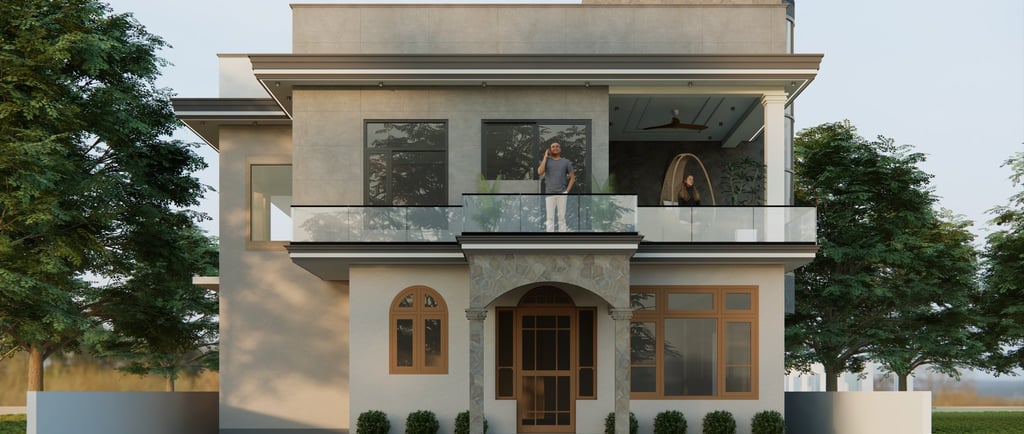
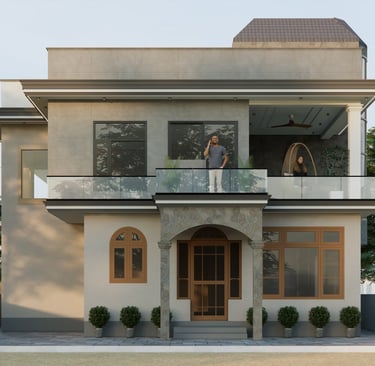
This residential project in Mandi is more than a structure; it is a design philosophy realized. It skillfully negotiates the timeless requirements of Himalayan architecture—durability, context, and rootedness—with the lightness and aspirational quality of global contemporary design. It is a testament to the fact that modern architecture can not only coexist with regional heritage but can actively enhance it, creating homes that are both sanctuaries and statement pieces.
At TSI, we continue to explore this synthesis, crafting unique spaces that resonate deeply with their geographic and cultural coordinates. We invite you to view this project as the benchmark for a new era of contextual residential design in Himachal Pradesh.
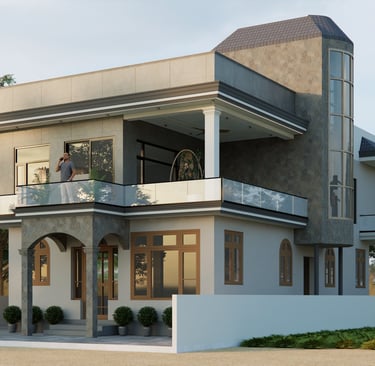
At TSI, we believe that true architecture is a conversation between form, function, and the environment it inhabits. Our recently completed residential project in the historic and scenic city of Mandi, nestled in the heart of Himachal Pradesh, stands as a testament to this philosophy. This design was not merely about constructing a house; it was about curating a landmark—a durable, contemporary dwelling that pays homage to the majestic Himalayan context.
This 800-word deep dive explores the architectural and material choices that define this unique home, positioning it as an exemplar of contextual modernism in the challenging, yet inspiring, terrain of North India.
I. The Imperative of Context: Design in the Himalayas
Designing in Himachal Pradesh presents a dual challenge: addressing the high seismic zone and harsh climatic conditions (heavy rain, snow, temperature variations) while respecting the region's rich, stone-centric vernacular aesthetic. Our approach was to synthesize these demands into a robust, yet aesthetically sophisticated, form.
The design successfully avoids the pitfalls of imported styles, instead interpreting the concept of "Himalayan Modern." The structure exhibits a grounded permanence, essential for the hill slopes, achieved through strategic massing. The foundation and lower levels provide a sense of rootedness, setting a sturdy platform for the lighter, more open volume of the upper floor. This strategic composition ensures both structural integrity and a visual dialogue with the surrounding topography, making the house feel like it belongs to the landscape, rather than simply placed upon it.
II. Architectural Vocabulary: A Dialogue of Forms
The defining characteristic of this Mandi residence is its masterful juxtaposition of contemporary and traditional architectural elements, resulting in an aesthetically coherent 'fusion' style.
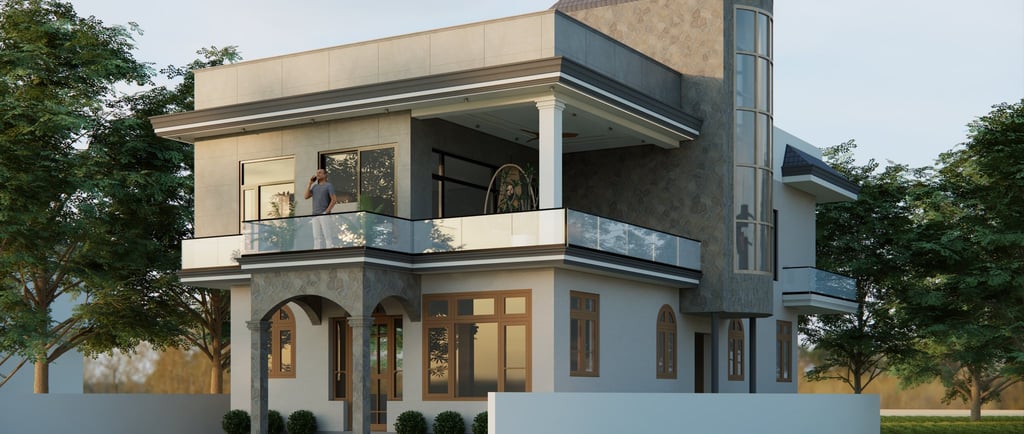
The Contemporary Block: The main two-story mass presents clean, horizontal lines, emphasizing the modern aesthetic. The expansive, flat-roofed terrace on the upper floor, recessed for protection and privacy, utilizes sleek, frameless glass balustrades. This choice maximizes uninterrupted views, a crucial feature for any property in the region, and introduces transparency and lightness to the composition. Large, dark-framed glazing ensures ample natural light penetration—a vital functional necessity given the region's often overcast days—while framing the external scenery as living artwork.
The Traditional Anchor: Contrasting sharply with the modern rectilinear form is a striking vertical element—a turret-like volume clad entirely in rough-hewn, natural stone. This element serves as the home's visual anchor and focal point. Architecturally, it breaks the monotony of the horizontal massing, injecting a dynamic verticality. Functionally, this core likely houses the main vertical circulation (staircase or private lift), offering a robust, sheltered access point that hints at the defensive solidity of traditional hill architecture. The material selection here is a deliberate nod to the regional stone architecture, grounding the home in the local material tradition.
A second traditional nod is seen in the entry porch. The use of an arched opening supported by slender columns provides a formal, welcoming transition space. Clad in a similar rough stone, this entrance ties the modern façade back to a classical sense of arrival.
III. The Art of Material Juxtaposition
The material palette is purposefully restrained, allowing the texture and play of light to define the aesthetic depth.
The Smooth and the Rough: The primary wall surfaces are rendered in a light, neutral-toned stucco or smooth concrete. This cool, matte finish provides the perfect canvas against which the rugged texture of the dark grey stone cladding is dramatically highlighted. This textural juxtaposition is a signature of high-end contemporary design, where simplicity meets tactility. The use of natural stone, apart from its aesthetic appeal, offers superior durability against the elements—a non-negotiable factor in the Himalayan climate.
Warmth of Wood: To soften the potential austerity of the stone and grey concrete, warm-toned wooden frames are used for the main windows and doors. This use of wood introduces a much-needed domestic warmth and reinforces the structure's human scale. It creates visual balance, bridging the gap between the cool, modern materials and the rugged, natural environment.
Transparency: The extensive use of glass, particularly in the balcony railings and the central vertical volume, ensures the building remains porous and light. It is a clear statement of contemporary living—prioritizing views and internal brightness.
IV. Functional Design & Spatial Integrity
Beyond the aesthetic appeal, the design prioritizes a highly functional layout that maximizes the site’s potential for outdoor living and natural light. The generously sized, semi-covered upper terrace is undoubtedly the social heart of the home, designed to be an extension of the indoor living space. Sheltered by the roof overhang, it offers a perfect space for relaxation and enjoyment of the mountain air, regardless of the sun or light rain.
The strategic placement of the large windows ensures cross-ventilation, aiding in passive cooling during warmer months, while maximizing solar heat gain when needed. Furthermore, the intentional variation in window shapes—from the large rectilinear panes of the contemporary section to the more traditional arched and segmented windows—adds architectural interest and suggests a careful zoning of interior spaces.