Why Flatland Construction Techniques Fail in the Mountains
The construction industry is undergoing significant transformations, particularly in specialized areas like mountain construction. Traditional flatland construction techniques often prove inadequate when adapted to the unique challenges posed by mountainous terrains.
DESIGN NOTES (TSI ARCHITECTS & ENGINEERS)
TSI Architects & Engineers
7/6/20267 min read
Understanding Flatland Construction Techniques
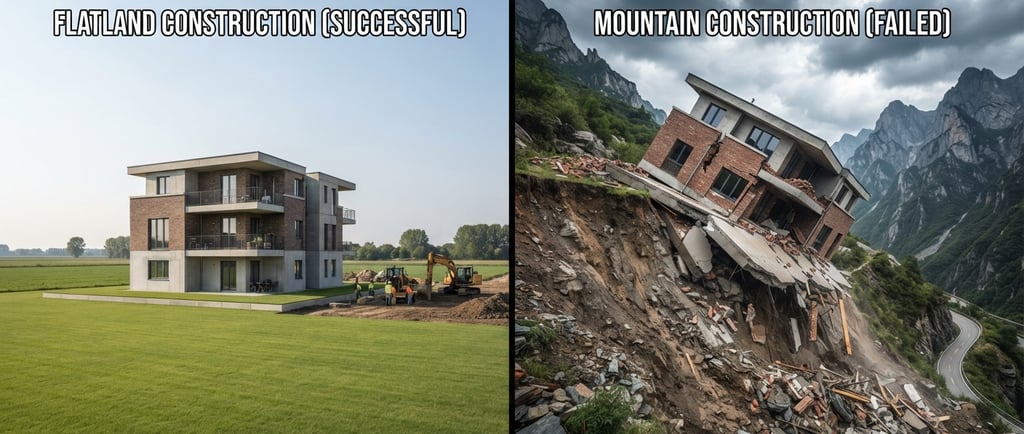
Flatland construction techniques are primarily designed for utilization in areas characterized by minimal elevation change and stable ground conditions. These methodologies are predicated on the fundamental principles of foundational stability, which are crucial for ensuring the safety and longevity of structures. The construction practices employed in flat terrains typically involve a thorough assessment of soil composition, as the stability of a building's foundation greatly depends on the soil's bearing capacity.
In flatland environments, builders often rely on standardized practices that promote efficiency and cost-effectiveness. Common methodologies include the use of reinforced concrete foundations, which provide a solid base for structures and are particularly effective in distributing the weight of the building evenly across the ground. The availability of materials such as steel and concrete in many regions further contributes to the widespread adoption of these techniques, making them not just practical but also economical.
Moreover, the simplicity of flatland construction design allows for streamlined workflows, enabling builders to complete projects within shorter timeframes while adhering to safety regulations. The predictability of the terrain enhances planning and execution, resulting in reduced risks associated with labor and material costs. Due to these factors, flatland construction techniques have gained popularity, particularly in urban and suburban areas where flat surfaces are prevalent.
Understanding these techniques is essential when examining the challenges faced when applying them in mountainous regions. The differences in soil stability, environmental conditions, and topographical considerations prompt a reevaluation of flatland practices in elevated terrains, highlighting their limitations and inadequacies in overcoming the complexities posed by such landscapes.
The Unique Challenges of Mountain Terrain
Mountainous terrains present a distinct set of challenges that significantly affect construction techniques typically effective in flatland environments. One of the primary concerns in these regions is the presence of steep gradients. Buildings constructed on slopes face risks such as erosion and structural instability, leading to potential collapse. Designing for steep slopes requires specialized engineering solutions, which differ greatly from standard practices deployed in flatter landscapes.
Another critical factor is the soil conditions prevalent in mountainous areas. Frequently, the soil can be loose and susceptible to shifting, particularly after heavy rainfall or thawing of snow. This instability poses a serious threat to construction projects, as the foundation must not only support the structure but also adapt to ongoing soil movement. Engineers and architects need to thoroughly analyze soil composition and consider employing advanced stabilization techniques to mitigate these risks effectively.
The weather in mountainous terrains is also markedly different from flatlands, with sudden changes in temperature and precipitation common. These variations can severely impact construction schedules and the materials used. For instance, winter weather, including snow and freezing temperatures, can hinder the progress of outdoor work, requiring construction timelines to be more flexible and adjustable. Additionally, the risk of landslides and avalanches during or after heavy storms must be factored into the planning stages.
Lastly, the seismic activity in certain mountainous regions introduces another layer of complexity. Earthquakes can cause significant damage to structures, necessitating the incorporation of resilient architectural designs. Flatland construction techniques may not suffice under such conditions, as they often do not account for the dynamic forces involved during seismic events.
Case Studies of Failure in Mountainous Construction
Examining construction failures in mountainous regions reveals significant insights into the pitfalls of applying flatland construction techniques. One notable case occurred in the Swiss Alps, where a ski resort development aimed to attract winter sports enthusiasts. The project utilized standard flatland approaches, including conventional excavation and grading methods. However, this led to severe erosion and destabilization of the ground, ultimately resulting in landslides that devastated both the resort and surrounding habitats.
Another example comes from a highway construction project in the Rocky Mountains. Engineers employed traditional flatland road-building methods which were ill-suited for the rugged terrain. The outcome was a series of road collapses during the first winter, causing hazardous conditions for motorists. Investigations revealed that inadequate drainage systems contributed to the failure, as water accumulation on the slopes severely undermined the road's structure.
In the Andes, a series of residential buildings faced catastrophic failure when they were constructed using techniques typical of urban flatland areas. The lack of consideration for soil composition and the steep topography led to structural cracks and an eventual collapse. Residents were forced to evacuate, highlighting the human cost of overlooking the unique challenges posed by mountainous environments.
Each of these case studies illustrates the necessity for specialized construction methods tailored to mountainous conditions. Learning from these errors emphasizes the importance of geological assessments, unique engineering strategies, and adaptive construction practices. These lessons have prompted subsequent projects to prioritize region-specific techniques, thereby reducing the likelihood of similar failures. Future development in mountainous regions must integrate these experiences to enhance the performance and safety of construction outcomes.
The Role of Geotechnical Engineering in Mountain Construction
Geotechnical engineering is a critical discipline that ensures the safety and structural integrity of construction projects, especially in mountainous regions. Given the unique geological features and challenging conditions present in such environments, understanding the underlying soil and rock mechanics becomes imperative. Mountain construction requires detailed geotechnical surveys to accurately assess the terrain and its suitability for various types of buildings.
One of the primary functions of geotechnical engineering in mountain construction is slope stability analysis. Since mountains are often characterized by steep slopes, the potential for landslides and soil failure is significantly increased. A thorough slope stability analysis helps engineers identify potential hazards and determine the types of retaining structures and drainage solutions necessary to mitigate risks. This process involves evaluating factors such as soil composition, moisture content, and loading conditions, which collectively influence the stability of slopes.
In addition to slope stability, soil testing plays a vital role in mountain construction. Soil characteristics, such as cohesion, friction angle, and permeability, are assessed through comprehensive tests, including undisturbed sampling and borehole investigations. These tests not only help establish the mechanical properties of the soil but also provide insights into potential challenges that may arise during construction. For instance, a high water table or weak soil conditions can significantly affect the choice of foundation design.
Moreover, adapting construction designs based on geological assessment findings is essential for successful outcomes in mountain environments. Geotechnical engineers often collaborate with architects and contractors to modify building techniques that align with the geotechnical data. By incorporating findings into the design phase, engineers can enhance the resilience and longevity of structures in these challenging settings.
Adaptive Techniques for Mountain Construction
Mountains present unique challenges for construction, necessitating the adaptation of techniques traditionally used in flatland scenarios. Effective mountain construction requires innovations that prioritize stability, safety, and environmental compatibility. One prominent adaptation is the technique of terracing. By creating stepped levels on sloped terrain, builders can prevent soil erosion and manage water runoff more effectively. Terracing not only facilitates construction but also creates flat areas for buildings, landscaping, and agriculture, thereby optimizing the use of mountainous landscapes.
Additionally, the use of supports and anchors plays a crucial role in mountain construction. Various support structures, including retaining walls and deep foundations, offer necessary reinforcement against landslides and soil movement inherent to mountainous regions. These supports stabilize structures by distributing weight more evenly and counteracting lateral forces exerted by the mountainside. Anchors, including rock anchors and soil nails, ensure that buildings are securely fastened to bedrock or stable soil layers, enhancing their integrity.
Material choices are equally important when constructing in mountainous areas. Lightweight, yet durable materials are often preferred to minimize the risk of structural failure due to the challenges posed by topography and environmental conditions. Utilizing materials that are resistant to harsh weather conditions, such as heavy snowfall or intense winds, can significantly enhance a construction project's longevity and reliability.
The integration of these advanced methods into construction practices not only improves the safety and stability of buildings in mountainous environments but also helps in reducing the ecological footprint of construction activities. By considering the challenges posed by elevation and terrain, builders can ensure that their projects are well-suited for mountain habitats, ultimately safeguarding both the structure and the surrounding landscape.
Regulatory and Environmental Considerations
The construction industry is governed by a plethora of regulatory and environmental rules that significantly impact construction practices, particularly in mountainous areas. Local building codes are fundamental in dictating the safety and sustainability of construction projects. These codes often require designers and builders to comply with stringent standards that accommodate the unique challenges posed by mountainous terrain. For example, requirements related to structural integrity, slope stability, and foundation depth can be considerably different from those applicable in flatland contexts.
Additionally, land use policies play a crucial role in shaping the construction landscape in mountainous regions. These policies are typically designed to balance development with the preservation of the natural environment. They may restrict development in certain areas to protect wildlife habitats, preserve natural views, and maintain the ecological balance. Failure to adhere to these land use regulations can lead to severe legal repercussions, including fines and project delays, which can significantly impact budgets and timelines.
Environmental impact assessments (EIA) are another pivotal component in the construction process, particularly in sensitive mountainous areas. An EIA evaluates the potential effects of a proposed construction project on the surrounding environment, including air and water quality, soil stability, and local ecosystems. This process not only highlights potential environmental risks but also encourages the adoption of more responsible construction practices. Compliance with EIA findings may necessitate design modifications or alternative construction techniques, ensuring that projects not only meet regulatory requirements but also contribute positively to the environment.
Overall, navigating the complex framework of regulations and environmental considerations is essential for successful construction in mountainous regions. Such compliance not only mends the gaps between development and conservation but also fosters innovative designs tailored to the specific needs of these challenging landscapes.
Looking Forward: Future Trends in Mountain Construction
The construction industry is undergoing significant transformations, particularly in specialized areas like mountain construction. Traditional flatland construction techniques often prove inadequate when adapted to the unique challenges posed by mountainous terrains. As we look to the future, innovative solutions are emerging that aim to address these challenges effectively.
One of the most promising trends is the use of advanced materials that offer enhanced durability and flexibility. Lightweight yet strong materials, such as engineered wood and composite materials, are becoming increasingly popular. These materials can not only withstand the environmental stresses often found in mountain regions but also contribute to more sustainable building practices. Furthermore, developing biodegradable and recyclable building materials aligns with the growing commitment to eco-friendly construction.
Another key area of focus is the integration of technology into the construction process. The use of 3D modeling enables engineers and architects to create highly detailed plans that account for the complex topography of mountainous areas. This technology aids in visualizing structural integrity and optimizing design choices before actual construction begins. In conjunction with 3D modeling, drone surveys are being utilized to gather essential data about inaccessible terrain. This provides real-time information that enhances decision-making and reduces potential risks associated with construction.
Sustainable practices are also being emphasized in future mountain construction projects. Embracing renewable energy sources, such as solar panels and wind turbines, can help in reducing a building’s carbon footprint. Innovations like green roofs and rainwater harvesting systems further integrate sustainability into mountainous construction, promoting a harmonious relationship between structures and the environment.
As these trends continue to evolve, they present the opportunity to create safer, more efficient structures in mountainous environments. Utilizing advanced materials, technology, and sustainable practices will help to mitigate the risks associated with traditional flatland construction techniques, ensuring a well-adapted approach to all future mountain construction projects.